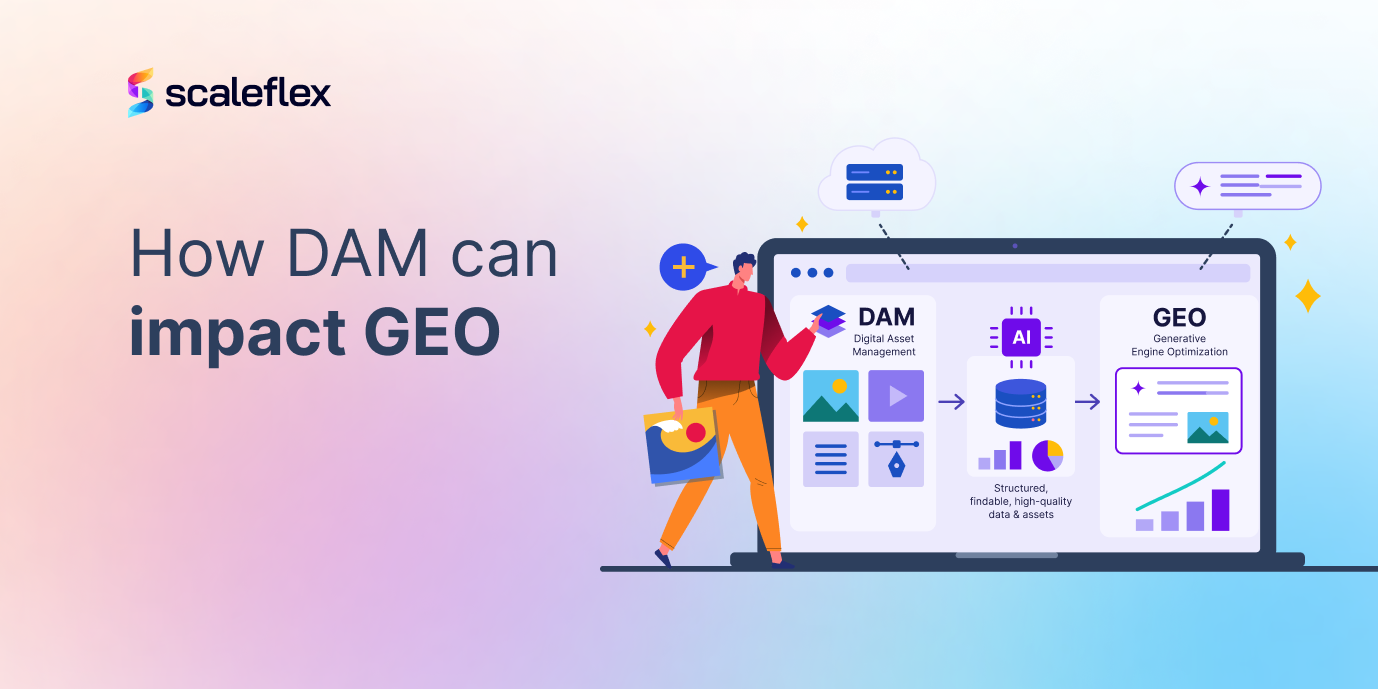
Ask ChatGPT for the best waterproof hiking boots under €150 and you won’t get ten blue links. You’ll get a short answer naming a handful of brands, often with photos and a line on why each pair made the cut. So why those brands and not others?
Part of the answer is generative engine optimization, or GEO. SEO helps you rank on Google, while GEO helps you get named when an AI tool answers a question your customers are asking.
The catch: AI tools only recommend what they understand. And images are where most brands leave them guessing. A product photo called IMG_0042.jpg tells an AI nothing about the navy wool coat inside it.
In this guide, we explain GEO in plain words, show you how AI tools “read” pictures and walk you through the simple fixes that make your images visible to them. No technical background needed.
What is GEO and how is it different from SEO?
So, what is generative engine optimization? It’s making your content easy for AI to find, understand and recommend. Tools like ChatGPT, Perplexity and Google’s AI Overviews don’t just list websites. They read many pages, pick the clearest facts and write one answer in plain language.
The term comes from a 2023 research paper by Princeton University, Georgia Tech, the Allen Institute for AI and IIT Delhi. The researchers found that simple content changes could boost AI visibility by up to 40%.
SEO (search engine optimisation) has been around since the late 1990s. Its job is to win the click by getting your website high up in Google’s results.
When you compare generative engine optimization vs traditional SEO, the real difference is where you show up. With SEO, you’re one link in a list. With GEO, you’re named inside the answer itself. AI tools also reward clear, specific facts they can quote with confidence.
The two aren’t rivals. Google says in its own guidance that its AI features rest on the same ranking systems as classic search. So good SEO is still the foundation. GEO simply adds a new question: when an AI writes its answer, does it mention you?
A simple way to picture it: SEO gets your shop onto the high street. GEO makes sure that when a passer-by asks a local for a recommendation, yours is the name that comes up.
Why does visual content matter so much for AI search?
Images matter because they shape how people shop and decide. On a product page, you look at the photos before you read a word.
Today, many AI tools can look at pictures as well as text. Point Google Lens at a plant, or upload a photo to ChatGPT and ask what’s in it, and you’ll get a sensible answer. Images are no longer just decoration. They’re information.
This is why generative engine optimization for ecommerce starts with images. A fashion label or a furniture retailer may publish thousands of product photos, each with only a short paragraph of text. For these brands, images carry a big share of the message.
If those photos are hard to understand, AI tools can’t tell your navy wool coat from any other dark jacket, so they can’t recommend it with confidence.
For B2B, generative engine optimization works the same way. A manufacturer’s technical drawings, a software company’s screenshots or a supplier’s product diagrams all help an AI explain what you offer. Clear visuals make you easier to recommend.
How do AI engines read an image?
AI tools read an image by looking at the picture itself and at the clues around it. Think of the AI as a detective: the more clues, the faster the case closes. Here are the six clues that matter most.
- A descriptive file name comes first. “navy-wool-coat-women.jpg” says far more than “IMG_0042.jpg”. Google’s image SEO guidelines recommend short, descriptive file names for exactly this reason.
- The web address adds useful context. The path where the image lives, such as /coats/navy-wool-coat, tells an AI what it is and where it belongs.
- Alt text describes the image in words. It was created for people using screen readers, and Google calls it the most important piece of information attached to an image.
- Surrounding words fill in the gaps. Product names, descriptions and captions near the image help an AI work out what it’s looking at.
- Structured data labels the page for machines. This small piece of hidden code says: this is a product, this is its price, this is its photo. Your web team will know it well.
- The picture itself must be readable. Modern AI recognises colours, shapes and objects. A blurry or cluttered photo is harder to read, for machines and people alike.
Why do most product images stay invisible?
Most product images stay invisible because nobody had AI in mind at upload. They were made for human shoppers, who glance at a photo and instantly see a navy wool coat.
The first culprit is the file name. Somewhere on most websites sits a folder full of IMG_0042.jpg, final_v3.jpg and everyone’s favourite, final_v3_REAL.jpg. Those names mean nothing to an AI.
Next comes missing alt text and patchy metadata. On many sites, the description field is simply left empty, because writing it by hand feels endless across thousands of photos.
Then there’s quality. Photos shot by different teams, in different studios, years apart, rarely look consistent. Some are blurry, dark or cluttered, with the product lost in a busy background.
Finally, heavy files slow pages down. Slow pages frustrate shoppers, and Google takes page experience into account. That matters here too, because AI tools often draw on the same pages that rank well.
None of these mistakes is unusual. They build up quietly, one upload at a time. The result is a catalogue that looks fine to people, but silent to machines.
What makes an image GEO ready?
A GEO-ready image is one an AI tool can understand without guessing. In practice, it ticks five boxes, which also sum up the core generative engine optimization (GEO) best practices for visuals:
- A clear file name that describes what’s in the picture
- A matching web address that follows the same logic
- A short, descriptive alt text written for humans first
- Good, consistent visual quality: sharp and well lit
- A clean, simple background for product shots
Add fast-loading files on top, and you’ve covered the basics. None of this is new to good SEO. That’s the point: GEO builds on image habits that already pay off on Google.
To check a single image, ask one question: could someone describe it without seeing it? If the file name and alt text alone tell them it’s a “women’s navy wool coat, front view”, you’re in good shape.
How can you make thousands of images GEO ready?
For a handful of photos, you could do all of this by hand. For a catalogue of thousands, it quickly becomes a full-time job nobody signed up for. The answer is to make the right steps happen automatically at upload.
This is where we can help. Scaleflex stores, organises and delivers your images and videos in one place, and it now prepares them for AI search automatically. Brands such as Kering, Michelin and Costa Coffee already trust us with their visual content.
- Image-to-text writes your alt text. It looks at each photo and writes a clear description, ready to use.
- Renaming fixes files and web addresses. “IMG_0042.jpg” becomes “navy-wool-coat-women.jpg”, and the web address follows.
- Quality checks catch weak photos. Images that fall short are flagged and improved.
- Background removal cleans up product shots. Busy backgrounds are replaced with a clean white one.
- Fast delivery keeps pages light. Every image is served in the right size and format for each device.
Whether you have 500 photos or 500,000, the same rules apply to every one, so your catalogue stays consistent across channels. For the more technical side, read our guide to how image optimisation and delivery support GEO and AEO.
For Scaleflex customers, these features come at no extra cost as part of the platform. Some draw on your Visual AI credits.
Conclusion
AI tools are fast becoming a first stop for advice, whether people are choosing hiking boots, a sofa or a new supplier. When those tools write an answer, they mention the brands they understand best.
Images are a big part of that understanding. A photo with a clear name, a helpful description and good quality gives AI tools something to work with. A folder of IMG_0042.jpg files gives them nothing.
The reassuring part: GEO isn’t a mystery, and it doesn’t replace your SEO work. It simply asks you to label your content clearly, so machines can read it as easily as people can.
Start small. Pick one product range, check its file names, alt text and photo quality, and fix what’s missing. Then build from there, range by range. And if your catalogue runs into the thousands, our team is happy to do the heavy lifting with you.